Imagine a world without perfectly calibrated electronic signals. Our phones wouldn't connect, Wi-Fi would stutter into oblivion, medical diagnostics would falter, and advanced research would grind to a halt. At the heart of virtually every electronic system lies a precisely engineered signal, a meticulously crafted wave of information. Understanding the Principles of Signal Generation isn't just academic; it's fundamental to designing, testing, and troubleshooting the technology that powers our modern lives. This guide will take you behind the scenes, explaining how these crucial electronic signals are brought into existence, from a simple hum to complex data streams.
At a Glance: What You'll Learn About Signal Generation
- The Core Purpose: Signal generators are electronic instruments that create precise electrical signals with adjustable properties.
- Building Blocks: Learn about the key components like oscillators, modulators, and amplifiers that construct a signal.
- Types of Generators: Discover specialized devices, from basic function generators to sophisticated arbitrary waveform generators and RF signal sources.
- Real-World Impact: Explore how these signals are vital in communications, electronics testing, R&D, and medicine.
- Defining Quality: Understand what makes a signal effective, focusing on stability, purity, and accuracy.
- Keeping it Pristine: Get practical tips on maintaining and calibrating your signal generation equipment for peak performance.
What Exactly Are We Talking About? Demystifying Signal Generation
At its simplest, a signal generator is a highly specialized electronic instrument designed to produce controlled electrical signals. Think of it as a sculptor for electricity, capable of shaping raw energy into specific waveforms with precise characteristics. These aren't just random electrical pulses; they are carefully engineered outputs—sine waves, square waves, pulses, or even complex modulated signals—all designed to mimic specific conditions or carry particular information.
Whether you're validating a new circuit board, simulating a wireless environment for a 5G device, or precisely timing a medical instrument, signal generators deliver the exact electrical stimulus needed. These signals serve as the 'inputs' for devices under test (DUTs), allowing engineers and researchers to observe how a system responds under controlled, repeatable conditions. This capability is indispensable across diverse fields, from telecommunications to automotive electronics, and from aerospace to cutting-edge scientific research.
The Blueprint of a Signal: Key Components at Work
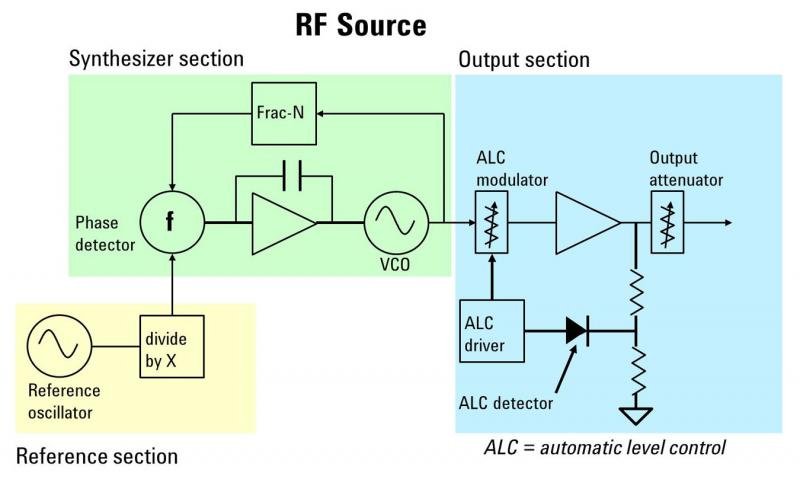
Crafting a precise electronic signal is a sophisticated ballet of specialized components, each playing a critical role in shaping the final output. While specific designs vary, most signal generators follow a common architectural pattern, taking a basic electrical oscillation and refining it into a complex, usable signal. Let's delve into these essential building blocks:
The Heartbeat: Oscillators and Voltage Controlled Oscillators (VCOs)
Every signal needs a starting point, a fundamental rhythm. This is where the oscillator comes in. An oscillator is an electronic circuit that produces a repetitive, oscillating electronic signal, often a pure sine wave, without any external input. It's the stable foundation upon which more complex signals are built.
A crucial evolution of the basic oscillator is the Voltage Controlled Oscillator (VCO). As its name suggests, a VCO's output frequency is directly dependent on a control voltage applied to it. This dynamic control is immensely powerful, allowing engineers to smoothly sweep frequencies, implement frequency modulation (FM), or precisely tune an output to a desired value simply by varying an input voltage. It's the difference between a fixed-pitch instrument and one that can play a full range of notes.
Frequency Shifters: Synthesizers and Multipliers
Once a basic frequency is established, it often needs to be adjusted, multiplied, or synthesized to meet specific application requirements.
- Frequency Synthesizers are sophisticated circuits that generate a wide range of frequencies from a single, fixed reference frequency. They achieve this through techniques like phase-locked loops (PLLs) and direct digital synthesis (DDS), offering highly stable and precise frequency control across a broad spectrum.
- Frequency Multipliers (and dividers) do exactly what they sound like: they take an input frequency and generate an output that is a multiple (or fraction) of that input. This is particularly useful for reaching very high frequencies from a more easily generated lower frequency source.
Adding Information: Modulators and Switches
A pure sine wave carries limited information. To make a signal useful for communications or complex testing, it often needs to be "modulated." Modulators are circuits that systematically vary one or more properties of the carrier wave (like its amplitude, frequency, or phase) in response to a modulating signal that carries the actual information. Common types include:
- Amplitude Modulation (AM): Varies the signal's strength.
- Frequency Modulation (FM): Varies the signal's frequency.
- Phase Modulation (PM): Varies the signal's phase angle.
These techniques add complexity and data-carrying capability, transforming a simple wave into a rich information stream. Switches, on the other hand, might control the routing or activation of different signal paths.
Blending Signals: The Mixer
Sometimes, multiple signals need to be combined into a single output. A mixer is an electronic circuit that takes two or more input signals of different frequencies and produces new signals at their sum and difference frequencies. This process, often used in radio frequency (RF) applications, allows for frequency conversion—shifting a signal from one frequency band to another—which is crucial for various communication protocols and testing scenarios.
Powering Up: Amplifiers
The signals generated by oscillators and other low-level components are often quite weak. An amplifier increases the power or amplitude of a signal without significantly altering its other characteristics. This ensures the signal is strong enough to drive the Device Under Test (DUT) or transmit effectively over a distance. Without amplification, many finely crafted signals would simply dissipate before they could do their job.
Taming the Output: Variable Attenuators
Just as an amplifier boosts a signal, a variable attenuator reduces its power or amplitude. This component is critical for preventing the signal generator from overloading the DUT, which could damage sensitive circuits. It allows the user to precisely dial in the desired output voltage level, ensuring that the signal presented to the DUT is exactly what's required for the test. This control is vital for conducting accurate and safe measurements.
The Final Delivery: Output Stage
The output stage is the final component in the signal generation chain. It's responsible for delivering the fully processed, conditioned, and appropriately powered signal to the DUT or other equipment. This stage often includes impedance matching circuits to ensure maximum power transfer and minimal signal reflection, guaranteeing the signal arrives at its destination cleanly and efficiently. For those who want to understand more about the specific characteristics of these emitted electrical pulses, you might want to Explore signal generator signals.
The Digital Revolution: DACs in Modern Generators
Modern signal generation, especially with Arbitrary Waveform Generators (AWGs), heavily relies on digital technology. At the heart of these devices are Digital-to-Analog Converters (DACs). A DAC takes a stream of digital data (which represents a waveform stored in memory as a series of voltage points over time) and converts it into a corresponding analog electrical signal. This allows for the creation of virtually any custom waveform shape, opening up a world of possibilities for complex testing and simulation. The precision and speed of these DACs are paramount to the fidelity of the generated signal.
A Spectrum of Signals: Different Generators for Different Needs
Just as a carpenter has a specific tool for every job, engineers rely on a diverse array of signal generators, each optimized for particular tasks and signal characteristics. While they all aim to produce electrical signals, their capabilities and applications can vary dramatically.
The Workhorse: Function Generators
For many general-purpose applications, the function generator is the go-to instrument. These devices produce basic, repeatable waveforms such as:
- Sine waves: Smooth, continuous oscillations, fundamental for AC analysis.
- Square waves: Instantaneous transitions between high and low states, essential for digital logic and timing.
- Triangle waves: Linear ramps up and down, useful for linearity testing and sweep generation.
- Sawtooth waves: A rapid rise followed by a slow, linear fall (or vice-versa), often used for scanning or timing.
Function generators allow users to adjust frequency, amplitude, and DC offset, making them invaluable for basic circuit testing, audio applications, and educational purposes.
An evolution in this category is the Arbitrary Function Generator (AFG). While still offering standard waveforms, AFGs also provide the ability to generate custom, user-defined waveforms, though typically with less fidelity and memory depth than a dedicated AWG. This blend of standard and arbitrary makes them incredibly versatile for engineers working with both conventional and unique signal requirements. If you're looking to understand the characteristics and applications of these basic shapes, you might find it useful delving into different waveform types.
The Master of Customization: Arbitrary Waveform Generators (AWGs)
When standard waveforms simply won't cut it, the Arbitrary Waveform Generator (AWG) steps in. AWGs are the most flexible of all signal generators, capable of creating virtually any waveform imaginable. How do they do this? By allowing the user to specify individual voltage values over time, which are then stored digitally and converted into an analog signal by a high-speed DAC.
This capability is crucial for:
- Complex Simulations: Replicating real-world signal imperfections, noise, or unique data patterns.
- Component Characterization: Precisely testing how components react to non-standard or highly specific inputs.
- Research & Development: Prototyping new modulation schemes or testing novel circuit designs that require signals beyond standard shapes.
AWGs are indispensable for advanced circuit design, radar systems, medical imaging, and anywhere precise, non-standard signals are a necessity.
The Timing Specialist: Pulse Generators
For digital circuits, timing is everything. Pulse generators are specialized instruments designed to create highly defined pulses with extremely precise control over their characteristics. Key adjustable parameters include:
- Pulse width: The duration of the pulse.
- Pulse rate (frequency): How often pulses occur.
- Amplitude: The voltage level of the pulse.
- Rise/fall times: How quickly the signal transitions between low and high states.
- Delay: The time between a trigger and the pulse output.
Pulse generators are critical for testing digital logic, clock synchronization, high-speed data communications, and simulating various timing scenarios in microcontrollers and processors.
The Wireless World Maestro: RF Signal Generators
When signals need to travel through the airwaves or operate at high frequencies, an RF Signal Generator is essential. These devices produce signals in the radio frequency (RF) range, typically from kilohertz (kHz) up to gigahertz (GHz), covering everything from AM/FM radio to cellular communications and satellite links.
RF signal generators are crucial for:
- Component Testing: Characterizing RF amplifiers, filters, and mixers.
- Receiver Testing: Evaluating the sensitivity, selectivity, and performance of wireless receivers.
- EMC/EMI Testing: Simulating interference conditions to ensure electronic devices comply with electromagnetic compatibility standards.
- Avionics and Military Radar: Generating the precise signals needed for radar systems, electronic warfare simulations, and aircraft communication testing.
For a deeper dive into the specific applications where these high-frequency tools shine, consider exploring common RF signal generator applications.
The Architect of Complex Wireless: Vector Signal Generators (VSGs)
An advanced subset of RF signal generators, Vector Signal Generators (VSGs) are the pinnacle of wireless signal creation. These instruments are designed to produce complex, digitally modulated signals with precise control over both amplitude and phase simultaneously. This "vector" control allows them to create signals that accurately represent modern wireless communication standards.
VSGs are indispensable for:
- Testing Wireless Communication Systems: Simulating Wi-Fi, LTE, 5G, Bluetooth, and other complex protocols.
- Modern Modulation Formats: Generating signals with advanced modulation schemes like Quadrature Amplitude Modulation (QAM), Orthogonal Frequency Division Multiplexing (OFDM), and more.
- Real-World Scenario Simulation: Adding impairments like fading, noise, and multipath interference to test receiver robustness under realistic conditions.
Essentially, a VSG allows engineers to simulate the intricate, real-world signals that carry voice, video, and data across our wireless networks, making them critical for developing and verifying the next generation of wireless technology. Understanding the complex ways these signals are encoded and transmitted is key to appreciating their power; you might want to learn more about advanced modulation techniques.
Beyond the Bench: Real-World Impact of Precise Signals
Signal generators are not just laboratory curiosities; they are foundational tools that enable the entire spectrum of modern electronics. Their ability to produce controlled, repeatable signals makes them indispensable across countless industries and applications.
Electronics Testing: The Bedrock of Design and Troubleshooting
Every electronic circuit, from the simplest toy to the most complex supercomputer, needs to be tested. Signal generators provide the necessary inputs to:
- Verify Circuit Performance: Ensuring components and entire circuits operate as designed across various conditions.
- Design Validation: Confirming new designs meet specifications before mass production.
- Troubleshooting and Debugging: Pinpointing faults by injecting known signals and observing deviations in expected output. For instance, an engineer might use a function generator to sweep an audio amplifier with a range of sine waves to test its frequency response, or a pulse generator to verify the timing of a digital logic gate.
Communications: Bridging Distances and Connecting Devices
The wireless world we inhabit wouldn't exist without sophisticated signal generation. These devices are critical for:
- Wireless Systems (Mobile Phones, Wi-Fi, GPS): Testing transceivers, base stations, and end-user devices by simulating realistic over-the-air signals. This includes evaluating sensitivity, power output, and error rates.
- Satellite Links & Fiber Optics: Generating the high-frequency and optical signals (often modulated by an RF signal generator) required to test the performance and integrity of communication channels that span continents and oceans.
- Network Device Prototyping: Accelerating the development of new communication standards by providing precise, reproducible test signals that mimic actual network traffic and interference.
Research & Development: Pushing the Boundaries of Innovation
In R&D, signal generators are the scientist's paintbrush, allowing them to create novel stimuli for groundbreaking experiments.
- Radar Systems: Simulating target returns and interference to develop more accurate and robust radar technologies for defense, weather forecasting, and autonomous vehicles.
- Electronic Warfare: Generating complex jamming signals or mimicking enemy communications to test defensive systems and training scenarios.
- Signal Processing: Creating custom waveforms to test new algorithms for filtering, compression, and analysis, driving advancements in fields from medical imaging to audio forensics.
Medical: Ensuring Precision in Healthcare
Accuracy is paramount in medicine. Signal generators play a vital role in ensuring medical devices function correctly.
- Calibrating Medical Devices: For example, calibrating an ECG (electrocardiogram) machine by feeding it a precise electrical signal that simulates a healthy heart's electrical activity, ensuring it accurately measures patient data.
- Troubleshooting: Diagnosing issues in diagnostic equipment or therapeutic devices by providing controlled inputs and observing system responses.
Audio Equipment: The Quest for Perfect Sound
Audiophiles and audio engineers rely on signal generators to achieve the highest fidelity.
- Testing Frequency Response: Generating pure sine waves across the audible spectrum to determine how well speakers, amplifiers, and microphones reproduce different frequencies.
- Measuring Distortion: Injecting known signals and analyzing the output for unwanted harmonics or intermodulation distortion, ensuring pristine sound quality.
The applications are truly endless, highlighting the foundational role these instruments play in our technologically driven society. The ability to precisely control and manipulate electrical signals is a core enabler of innovation.
The Mark of a Great Signal: What Defines Effectiveness?
Not all signals are created equal. The effectiveness of a signal generator—and the utility of the signals it produces—hinges on several critical performance parameters. These factors determine how accurately a generated signal represents its intended purpose and how reliably it can be used for testing or transmission. When choosing the right signal generator for your project, these specifications are paramount.
- Frequency Stability: How consistently the output frequency remains at its set value over time and under varying environmental conditions. Drift can lead to inaccurate measurements or communication errors. High stability is crucial for precision timing applications and coherent communication systems.
- Signal Purity (Low Harmonic Distortion): Ideally, a sine wave should contain only its fundamental frequency. Harmonic distortion refers to the presence of unwanted integer multiples of the fundamental frequency. A signal with high purity (low distortion) is essential for accurate measurements, as harmonics can introduce errors or interfere with other signals. This is closely related to the importance of signal purity and noise characteristics.
- Amplitude Accuracy: How precisely the output signal's voltage level matches its set value. Inaccurate amplitude can lead to incorrect power measurements, faulty component characterization, or misinterpretation of receiver sensitivity.
- Minimal Phase Noise: Phase noise refers to random, short-term fluctuations in the phase of a signal. While not always audible, high phase noise can degrade the performance of communication systems, leading to increased bit error rates or spectral spreading. It's particularly critical in RF and microwave applications.
- Modulation Fidelity: For modulated signals, this refers to how accurately the generator applies the desired modulation to the carrier wave. High modulation fidelity ensures that the information being encoded onto the signal is transmitted without distortion, preserving data integrity in communication systems.
Understanding these factors is key to selecting the right signal generator and interpreting its outputs correctly. A generator excelling in these areas provides trustworthy, repeatable results, which is the cornerstone of reliable engineering and scientific research.
Keeping Your Signals Pristine: Maintenance & Calibration Essentials
Even the most sophisticated signal generator is only as good as its last calibration. Over time, components drift, environmental factors take their toll, and accuracy can degrade. Ensuring the continued effectiveness and trustworthiness of your signal generation equipment requires a proactive approach to maintenance and calibration.
- Regular Calibration: This is arguably the most critical aspect. Signal generators require periodic calibration (typically annually, or more frequently for critical applications) to correct for frequency drift, amplitude errors, and waveform distortions. This involves comparing the generator's output against a highly accurate reference standard and making necessary adjustments. Always use certified calibration labs or equipment to ensure traceability to national standards.
- Operate in Temperature-Controlled Environments: Electronic components are sensitive to temperature fluctuations. Operating signal generators within their specified temperature range minimizes thermal drift, improving stability and accuracy. Extreme temperature changes can stress components and accelerate degradation.
- Verify Output Parameters Periodically: Even between formal calibrations, it's good practice to periodically verify key output parameters (e.g., a known frequency and amplitude) using another calibrated instrument, such as a spectrum analyzer or oscilloscope. This acts as a quick check for gross errors.
- Ensure Proper Input Power and Grounding: Stable and clean power is essential. Use appropriate power cords and ensure the instrument is properly grounded to prevent electrical noise from interfering with the generated signal and to protect against electrical hazards. Power fluctuations can affect frequency stability and overall performance.
- Periodic Firmware Updates: For modern digital and arbitrary waveform generators, firmware updates often include bug fixes, performance enhancements, and new features. Regularly checking for and applying these updates can improve instrument reliability and expand its capabilities. Always follow the manufacturer's guidelines for firmware updates.
By adhering to these practices, you can significantly extend the lifespan of your signal generator, ensure the accuracy of your measurements, and maintain confidence in the integrity of the signals you produce.
Navigating the Nuances: Common Questions & Misconceptions
As a fundamental piece of test equipment, signal generators often spark a few common questions. Let's clarify some of the most frequent queries:
Q: What's the biggest difference between an analog and a digital signal generator?
A: Analog generators produce waveforms directly using analog circuitry, often resulting in very pure, low-noise sine waves but with less flexibility. Digital generators (especially AWGs) use Digital-to-Analog Converters (DACs) to create waveforms from stored digital data, offering immense flexibility for custom shapes and modulation, though sometimes at the cost of higher phase noise at very high frequencies or extremely high resolution needs. Most modern high-end generators blend both digital control and analog output conditioning.
Q: Can one signal generator do everything?
A: Not effectively. While some advanced instruments offer broad capabilities (like an AFG providing both standard functions and arbitrary waveforms), no single generator excels at all tasks. A dedicated RF signal generator is typically superior for high-frequency purity than an AFG, and an AWG offers far more waveform flexibility than a basic function generator. The choice always depends on the specific requirements for frequency range, waveform type, modulation complexity, and signal fidelity.
Q: Why is "phase noise" so important, especially in RF?
A: Phase noise is random, rapid fluctuations in the phase of a signal. In RF communication, high phase noise can effectively "smear" the signal across adjacent frequency channels, causing interference and reducing data throughput. It makes it harder for receivers to accurately demodulate the signal, leading to more errors. For radar, it can reduce target detection capabilities. Minimizing phase noise is therefore crucial for high-performance wireless systems.
Q: How do I know which type of signal generator I need?
A: Start by defining your requirements:
- What waveform shapes? (Sine, square, pulse, arbitrary, modulated RF?)
- What frequency range? (Hz, kHz, MHz, GHz?)
- What amplitude range? (mV, V, dBm?)
- What level of accuracy/purity? (Low distortion, low phase noise, high stability?)
- Do you need modulation capabilities? (AM, FM, PM, digital modulation?)
- What's your budget?
Answering these questions will quickly narrow down the options from function generators to specialized RF or arbitrary waveform generators.
Crafting Tomorrow's Technology, One Signal at a Time
The principles of signal generation are more than just a theoretical concept; they are the practical foundation upon which countless electronic innovations are built. From the simple hum of an audio circuit to the complex data streams of 5G, every electronic signal has a story of precision engineering behind it.
By understanding the components that create these signals, the various types of generators designed for specific tasks, and the critical factors that define a signal's quality, you gain a deeper appreciation for the intricate dance of electrons that power our world. Moreover, by embracing the essentials of maintenance and calibration, you ensure that the signals you generate are not just present, but consistently accurate and reliable.
As technology continues its rapid evolution, the demand for ever more precise, flexible, and complex signal generation will only grow. Armed with this knowledge, you're better equipped to navigate the electronic landscape, whether you're troubleshooting a circuit, designing a new communication system, or simply marveling at the seamless connectivity that defines our modern existence. The future of electronics will continue to be sculpted, one perfectly generated signal at a time.