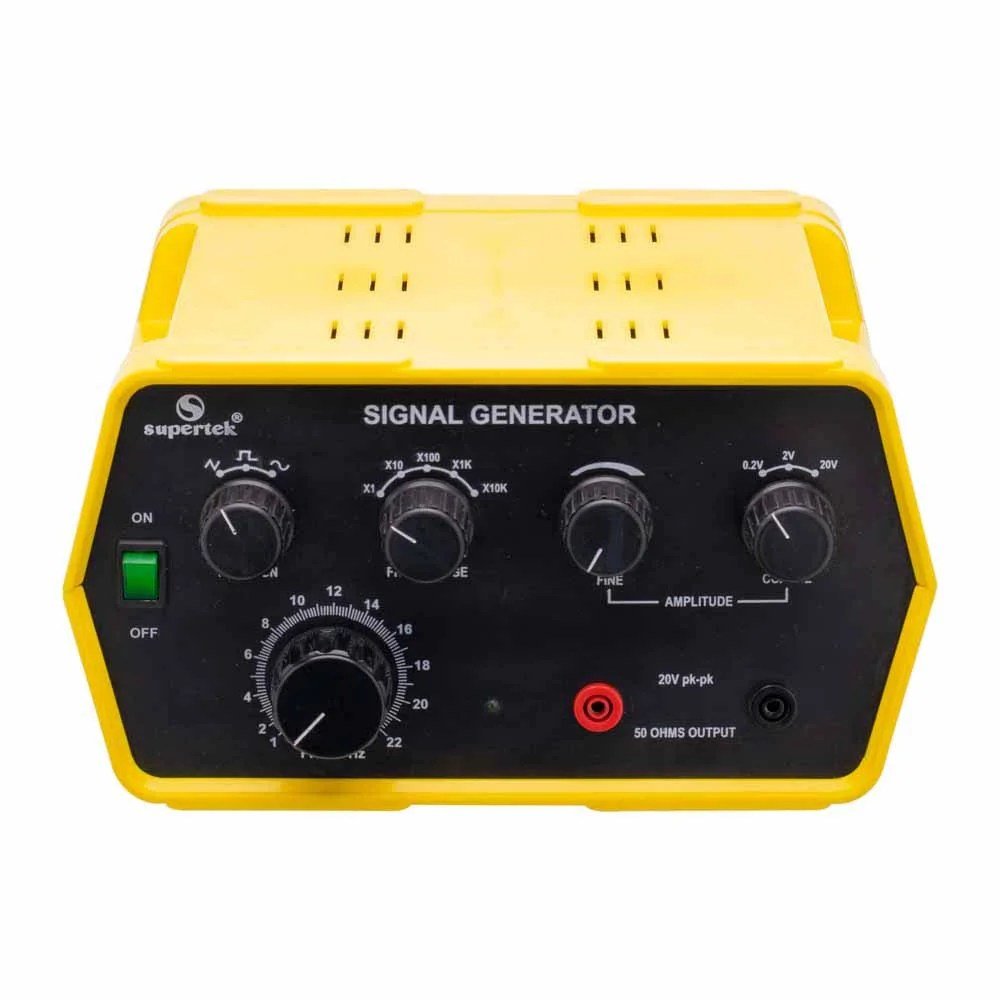
Choosing the right tools for your engineering challenges can feel like navigating a dense forest, especially when it comes to something as fundamental as selecting a signal generator. This isn't just about picking a device that makes waves; it's about investing in precision, reliability, and the foundational accuracy that underpins all your measurements, designs, and innovations. Get it wrong, and you could chase phantom issues or, worse, miss critical flaws in your product.
A signal generator is the heart of your test setup, allowing you to simulate real-world conditions, characterize components, and validate designs. But with a dizzying array of types and specifications, how do you cut through the noise and land on the instrument that truly meets your needs, now and in the future? This guide aims to clear that path, turning a complex decision into a clear, confident choice.
At a Glance: Your Signal Generator Selection Checklist
Before diving deep, here are the core considerations to keep front of mind:
- Application First: What are you actually trying to achieve? (e.g., RF testing, digital data simulation, general-purpose waveforms).
- Frequency Range: Does it cover your highest and lowest required frequencies, with headroom?
- Amplitude & Power: Can it deliver the necessary signal strength without additional amplification?
- Modulation Needs: Do you need simple AM/FM, complex digital modulation, or custom patterns?
- Spectral Purity: How critical are low phase noise and spurious emissions to your measurements?
- Waveform Complexity: Will you need standard sine/square waves, arbitrary custom shapes, or vector signals?
- Budget & Future-Proofing: What's your spending limit, and can the generator adapt to evolving needs?
- Software & Integration: How easily will it fit into your existing automated test environment?
What Exactly Is a Signal Generator, and Why Does It Matter?
At its core, a signal generator is an electronic device that creates and outputs a variety of electrical signals, often in the form of repeating or non-repeating waveforms. Think of it as a meticulously controlled signal source, allowing you to feed a known, precise input into a device under test (DUT) or a system. This controlled input then enables you to observe and measure how the DUT responds, helping you verify performance, troubleshoot problems, and ensure design integrity.
From calibrating oscilloscopes to stress-testing wireless communication systems, signal generators are indispensable. They are the bedrock of accurate measurement, providing the predictable stimulus needed to characterize everything from the simplest capacitor to the most advanced 5G transceivers. To truly appreciate their role, it helps to Learn about signal generator signals and their fundamental characteristics.
Deciphering the Main Types of Signal Generators
Not all signal generators are created equal. Their architecture, capabilities, and ideal applications vary significantly. Understanding these distinctions is your first critical step.
Radio Frequency (RF) Signal Generators: The RF Workhorse
If your work involves radio waves, wireless communication, radar, or any high-frequency electronics, an RF signal generator is likely your primary tool. These instruments specialize in producing high-frequency sine waves with excellent spectral purity, meaning very low noise and unwanted spurious signals. They are crucial for testing components like amplifiers, mixers, and filters, as well as entire RF systems.
Modern RF generators often include comprehensive modulation capabilities, allowing them to simulate various wireless standards. Their precision and stability are paramount for accurate characterization in demanding environments. Mastering this area often requires understanding RF signal fundamentals yourself.
Arbitrary Waveform Generators (AWGs): Crafting Complex Signals
When standard sine, square, or triangle waves aren't enough, an Arbitrary Waveform Generator (AWG) steps in. AWGs are designed to create virtually any electrical waveform you can define, point by point. This makes them incredibly versatile for simulating real-world anomalies, custom protocols, or complex digital signals that would be impossible with traditional function generators.
They are essential in applications ranging from automotive radar simulation and medical imaging to quantum computing research. The ability to upload custom data and replay it as an analog waveform gives AWGs a unique edge for highly specialized testing. You can explore arbitrary waveform generator applications to see their full potential.
Function Generators: Everyday Waveforms
Function generators are the workhorses of general electronics testing. They provide a range of standard waveforms—sine, square, triangle, ramp, and pulse—typically at lower frequencies (up to a few tens of MHz, though some reach higher). They are often found on educational benches, in R&D labs for basic circuit testing, and for audio applications.
While they may lack the precision and high-frequency capabilities of RF generators or the complex customizability of AWGs, function generators offer excellent value and simplicity for everyday tasks. They're usually more affordable and easier to operate for straightforward waveform generation.
Vector Signal Generators: The Heart of Modern Wireless
Vector signal generators (VSGs) are a specialized type of RF generator, indispensable for developing and testing modern wireless communication systems (like 5G, Wi-Fi, LTE, Bluetooth). Unlike simple RF generators that produce a continuous wave (CW) with basic modulation, VSGs generate complex modulated signals by controlling both the amplitude and phase of the carrier wave in real-time.
This capability, often referred to as I/Q (in-phase and quadrature) modulation, allows them to accurately replicate the intricate digital modulation schemes used in today's high-bandwidth wireless standards. If you're designing or testing transceivers, base stations, or wireless devices, a VSG is not just helpful—it's absolutely critical.
Key Specifications: What Numbers Truly Count?
Once you understand the types, the next step is to drill down into the specifications. These numbers aren't just technical jargon; they directly impact the accuracy, reliability, and suitability of a signal generator for your specific tasks.
Frequency Range: Your Operating Window
This is often the first specification people look at, and for good reason. The frequency range dictates the highest and lowest frequencies the generator can produce. Ensure the upper limit comfortably exceeds your highest required test frequency, accounting for potential future needs. Similarly, check the lower limit if you work with baseband or very low-frequency signals.
- Tip: Always consider a generator with a slightly higher maximum frequency than your immediate needs. This buffer can save you from premature obsolescence.
Amplitude and Output Power: Driving Your Device
The amplitude specifies the voltage level of the signal, while output power is often expressed in dBm. This determines how strongly your signal generator can drive a device under test. Will you need to test sensitive receivers, or will you be driving high-power amplifiers?
- Consider: Look for a wide dynamic range (maximum to minimum output power) and fine amplitude resolution. Some applications might also require a precise power level at the DUT input, necessitating consideration of cable losses.
Modulation Capabilities: Shaping the Signal
Modern electronics rarely use pure, unmodulated signals. Your signal generator needs to speak the language of your application.
- Analog Modulation: AM (Amplitude Modulation), FM (Frequency Modulation), PM (Phase Modulation) are common for basic radio and sensor testing.
- Digital Modulation: For wireless communication, you'll need support for complex schemes like QAM (Quadrature Amplitude Modulation), PSK (Phase Shift Keying), OFDM (Orthogonal Frequency Division Multiplexing), and more. Vector signal generators excel here.
- Pulse Modulation: Critical for radar, where signals are pulsed on and off with specific timing.
- Arbitrary Modulation: The ability to upload custom modulation patterns gives AWGs immense flexibility.
The depth and purity of modulation are critical. When dealing with wireless standards, it's worth taking time to delve into advanced modulation techniques to truly appreciate their complexity.
Phase Noise and Spectral Purity: The Unseen Influencers
Often overlooked, phase noise is a measure of the short-term random fluctuations in the phase of a signal. High phase noise means a "dirty" signal, which can mask subtle effects in your DUT, degrade receiver sensitivity, and lead to inaccurate measurements. Spectral purity refers to the absence of unwanted spurious signals (harmonics, sub-harmonics, non-harmonic spurs).
- Why it matters: In RF and microwave applications, poor phase noise can severely limit the performance of communication systems, radar, and high-speed data links. Always compare phase noise specifications, especially when testing sensitive receivers or high-performance oscillators. Understanding these metrics is vital, and you might even need to know how to measure phase noise accurately with other instruments.
Switching Speed: Agility for Automated Tests
In automated test environments, the speed at which a signal generator can change frequency, amplitude, or modulation schemes can significantly impact throughput. Faster switching speeds reduce test times, which translates directly to cost savings in production environments.
Memory Depth (for AWGs): The Length of Your Creation
For Arbitrary Waveform Generators, memory depth determines how long or complex a single arbitrary waveform can be. A deeper memory allows for longer, more detailed, or multi-segment waveforms without repetition, which is crucial for simulating realistic data streams or complex scenarios.
Harmonic and Spurious Performance: Keeping it Clean
Harmonics are integer multiples of your fundamental frequency, while spurious signals are unwanted frequency components not harmonically related. A high-quality signal generator will suppress these unwanted signals to very low levels. Poor harmonic performance can interfere with other signals or provide misleading test results.
Signal Integrity and Rise/Fall Times (for Digital Signals)
For testing high-speed digital circuits, the signal generator's ability to produce clean, fast-rising, and fast-falling pulses is crucial. Look at specifications like rise/fall times, overshoot, and flatness. An AWG with high sampling rates and good analog performance is often needed for these applications.
Matching the Generator to Your Application: Real-World Scenarios
The "best" signal generator doesn't exist in a vacuum; it's always the best tool for your specific job.
Wireless Communications (5G, Wi-Fi, Bluetooth)
- Need: Vector Signal Generators (VSGs) are non-negotiable here. You'll need advanced digital modulation capabilities (QAM, OFDM), wide bandwidths for signal creation, and excellent error vector magnitude (EVM) performance to simulate and test modern wireless standards. Low phase noise is critical for receiver sensitivity.
- Consider: Multi-channel options for MIMO testing, real-time waveform generation, and support for specific communication standards.
Radar and Electronic Warfare (EW)
- Need: High-frequency RF signal generators with excellent pulse modulation capabilities (fast rise/fall times, high on/off ratio). Very low phase noise is paramount for detecting small targets or jamming effectiveness. AWGs might be used for complex pulse sequences or chirped radar signals.
- Consider: Wide instantaneous bandwidth for creating complex radar chirps, frequency hopping, and agile threats.
Component Testing (Amplifiers, Filters, Mixers)
- Need: General-purpose RF signal generators with wide frequency and amplitude ranges, good spectral purity (low harmonics and spurs), and stable output power. For mixers, two or more synchronized generators might be required.
- Consider: Fast frequency switching for automated characterization sweeps, and often, an integrated power meter for precise level setting.
Research & Development, Education
- Need: Flexibility is key. For fundamental physics or general electronics, a versatile function generator might suffice. For advanced research, an AWG or a high-performance RF generator with advanced modulation could be essential.
- Consider: Ease of use, programming interfaces, and affordability are often factors, especially in educational settings.
Automotive (ADAS, IoT)
- Need: Depending on the application, this could range from general-purpose function generators for sensor simulation to high-frequency radar target simulators (often AWGs or specialized VSGs) for ADAS development.
- Consider: Robustness, specific automotive bus interfaces, and the ability to simulate environmental conditions.
Beyond the Specs: Practical Considerations for Smart Selection
The numbers tell part of the story, but practical realities fill in the rest.
Budget vs. Performance: The Sweet Spot
Signal generators span a vast price range, from a few hundred dollars for basic function generators to hundreds of thousands for cutting-edge VSGs. Don't overspend on capabilities you'll never use, but don't under-spec and find yourself limited.
- Strategy: Identify your absolute must-have specifications, then look at models that meet those. Consider options for upgrades or rental if a specific capability is needed only occasionally. Remember, the total cost of ownership also includes calibration and maintenance.
Future-Proofing Your Investment: Scalability and Upgrades
Technology evolves rapidly. Can the signal generator you're considering be upgraded in the future (e.g., software options, frequency extensions, additional modulation capabilities)? A modular platform, like PXI or a highly configurable benchtop unit, often offers better long-term value.
Software Integration and User Interface: Workflow Matters
How intuitive is the front panel? How easy is it to program via SCPI commands, LabVIEW, or other software? Good software integration can dramatically improve efficiency in automated test setups. Consider a demo or trial to assess usability.
Portability and Form Factor: Benchtop, PXI, USB
- Benchtop: The most common form factor, offering dedicated controls, displays, and often excellent performance.
- PXI/PXIe: Modular instruments designed for automated test systems, offering high channel density and excellent synchronization. Ideal for complex multi-channel tests.
- USB/Modular: Compact, often bus-powered devices controlled by a PC. Great for basic field testing, education, or space-constrained labs, but might have performance limitations compared to benchtop units.
Your choice here depends on your lab space, need for automation, and mobility requirements. When considering multiple types of equipment, it helps to understand the broader landscape of test equipment and how different form factors fit in.
Support and Calibration: The Long-Term View
A signal generator is an investment. What kind of technical support does the manufacturer offer? What are the recommended calibration intervals and costs? Reliable support and traceable calibration are vital for maintaining measurement accuracy and compliance. Leading manufacturers like Keysight offer extensive global support networks.
Common Pitfalls to Avoid When Selecting a Signal Generator
Even experienced engineers can stumble during the selection process. Watch out for these common missteps:
- Over-specifying vs. Under-specifying: Don't buy a Ferrari for a trip to the grocery store, but don't buy a bicycle for a cross-country journey either. Carefully match specs to your real needs, with a slight buffer for future growth, but avoid features you'll never use.
- Ignoring Phase Noise and Spectral Purity: These "invisible" specs can be the difference between reliable data and frustrating, unexplainable measurement errors, especially in RF. Always ask for these specifications and understand their impact.
- Neglecting Software and Automation Needs: A powerful generator is hobbled if it's difficult to integrate into your automated test environment. Good drivers, APIs, and software support are as important as hardware specs for efficiency.
- Forgetting Calibration and Maintenance Costs: These ongoing costs can add up over the lifespan of the instrument. Factor them into your total cost of ownership.
- Focusing Solely on Price: While budget is a factor, prioritizing the lowest price often leads to compromises in performance, reliability, and ultimately, higher costs down the line due to inaccurate measurements or premature replacement.
Your Next Steps: Making an Informed Decision
Selecting a signal generator is a critical decision, but it doesn't have to be overwhelming. Start by clearly defining your primary application and the key parameters you absolutely need. Then, methodically evaluate frequency, amplitude, modulation, and spectral purity. Don't forget the practical aspects like integration, form factor, and long-term support.
Consider reaching out to multiple vendors, asking for detailed specifications, and even requesting a demonstration unit if possible. Talking to application engineers can often illuminate subtle differences or advanced features that might be perfectly suited for your unique challenges. By approaching this decision systematically and thoughtfully, you’ll secure an instrument that empowers your work for years to come, ensuring the accuracy and integrity of your critical measurements.